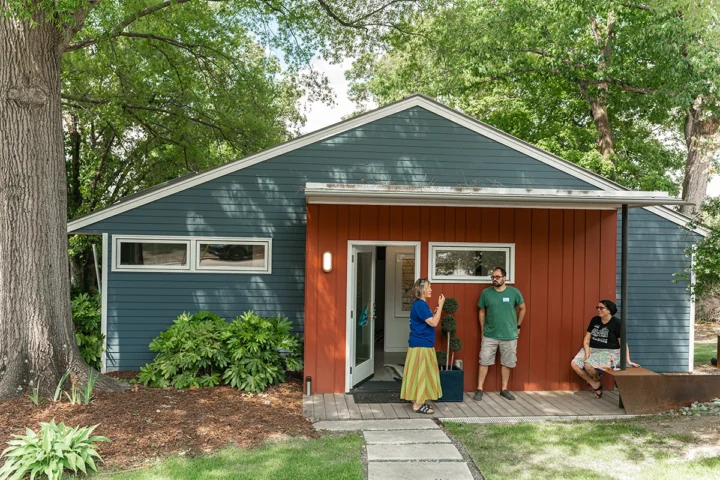
The City of Raleigh legalized Accessory Dwelling Units (ADUs) by-right, city wide in March 2020. Since then, over 250 permits have been applied for –– most are finalized or issued, some are still in review. The city has launched a website with information on ADUs and how to build them, conducted a competitive call for ADU designs, and created a “fast track program” that features “pre-reviewed” plans. There is an upward trend in applications, with the promise of a regular stream of new housing each year at no cost to the city.
What are Accessory Dwelling Units (ADUs)?
ADUs are an historic building type found in older, inner city neighborhoods nationwide. They are one of several ways to diversify housing stock. ADUs are smaller living units located in or attached to single family homes, above garages, or in backyards. They are also called guest houses, granny flats, and backyard cottages, which describe their uses and smaller size. ADUs give homeowners flexibility as family needs change – they can provide a place for a boomerang kid or an aging parent to live, or a way to downsize without moving out of one’s neighborhood.

ADUs can also be rented to help supplement household income or mortgage payments. Their smaller size can produce affordable housing units where they are most needed. By adding residents to existing neighborhoods, they use fewer resources, support walkable, transit-oriented communities, and are sustainable. They will not solve the housing crisis alone, but are an important piece of the housing puzzle.
Where are they being built?
ADUs are part of a national movement to fill the “missing middle” of flexible and neighborhood-scaled housing options. Major cities across America allow ADUs. Some even promote them because they recognize that growing, dynamic cities with housing challenges need diverse housing. All major North Carolina cities allow them, including Charlotte, Asheville, Durham, and Raleigh, and many are making them easier to build.
However, there are challenges for owners who want to build an ADU. The permitting process can be difficult to understand. They can be expensive per square foot, and zoning and building code requirements can increase site and construction costs. They can also be difficult to finance. Conventional mortgages often don’t pencil, and home equity loans, especially for low wealth households, often do not provide enough for construction costs.
ADUs in Raleigh
One can find ADUs in Oakwood, Mordecai, Forest Park, Boylan Heights, and other historic neighborhoods in Raleigh. However, in the 1970s Raleigh outlawed ADUs. This was during a time of suburban flight and urban decay exacerbated by absentee landlords. It wasn’t until the second decade of the 21 st Century that Raleigh reconsidered them. In 2013 a final draft of the Unified Development Ordinance allowed ADUs but was removed from the final document because of concerns voiced during public input sessions. In 2014 the Urban Design Center of the Planning Department requested a study by the Affordable Housing and Sustainable Communities Initiative at the School of Architecture, NC State. That fall graduate students worked with the Mordecai Citizen Advisory Council (CAC), the Person Street Partnership (a local business organization), and residents, to envision ADUs in the community.
At the conclusion of the project the Mordecai CAC petitioned the City Council to consider legalizing ADUs for their community. Lengthy debates and delays followed, with opponents, many from Raleigh’s inner-city neighborhoods, arguing that they would result in loss of neighborhood character, and increased traffic and noise. WakeUP Wake County stepped up to lead advocacy efforts and mobilize supporters. It wasn’t until 2018 that an ordinance permitting ADUs was approved. However, it included mandates that residents of each neighborhood vote to approve ADUs within specified boundaries. In the next year there were no requests to do so.
WakeUP Wake County continued its multi-faceted education and advocacy campaign, providing case-studies and statistics and conducting information sessions at Citizen Advisory Councils citywide. In 2019 a new council was elected and in 2020 one of their first acts was to make ADUs legal, citywide and by-right. Since then, the number of ADUs permitted and built has increased every year.
What’s next?
WakeUP Wake County and RaleighForward continue to lead efforts to ensure that ADUs fulfill their potential to provide accessible housing where it is most needed. They will host a public event in October that will provide key data, trends, and insights about ADUs in Raleigh. The event will present up-to-date figures on permitting activity, construction trends, financing strategies, occupancy, and community impact. It will also provide recommendations on how the city can clarify and streamline the process and provide additional incentives and support to homeowners. Through interactive presentations, panel discussions, and data visualization, the event will empower homeowners, policymakers, housing advocates, and developers with the knowledge they need to support the current success and future expansion of ADUs in the housing landscape.
Participate in the ADU Survey
I would like to invite you to participate in the ADU Survey, a first of its kind research project being conducted by WakeUp Wake County and RaleighForward, supported through generous donations from the Z. Smith Reynolds Foundation and contributions from PublicInput. You can find the survey here.